

The Neles GW series heavy-duty three-way control valve is designed for mixing and diverting services. It features an unbalanced, top- and seat-guided construction, pressure classes up to ASME 150–600, and operation from -29 to +425 °C, with SIL 3 certification and compliance with ISO 15848 low-emission requirements. Hardened trim surfaces are provided as standard for continuous mixing or diverting control of heat exchangers and process fluids.
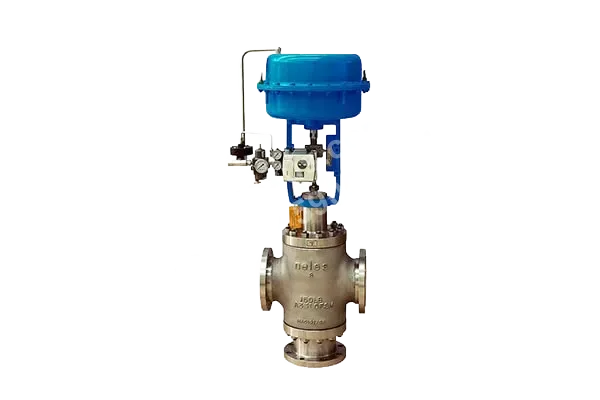
Neles three-way control valve, GW series
Neles
GW Series Heavy-Duty Three-Way Control Valve | Neles
Product code: GW
Heavy-duty three-way control valve designed for mixing and diverting services, suitable for heat exchangers and process fluid lines, with flanged-end or welded-end connection options.
- Category
- Globe Valves
- Nominal Size Range
- DN 25 - 250 / 1" - 10"
- Pressure Rating
- ASME 150 – 600 / PN10 – 100
Specifications
- Valve Design
- Unbalanced, top-guided and seat-guided
- Nominal Size Range
- DN 25 - 250 / 1" - 10"
- Pressure Rating
- ASME 150 – 600 / PN10 – 100
- Operating Temperature Range
- -29 to +425 °C / -20 to +797 °F
- Seat Leakage Class
- ANSI/FCI 70-2 Class II - IV
- End Connections
- Flanged or welded ends
- Low-Emission Standard
- In accordance with ISO 15848, with optional bellows packing
- Material Options
- NACE material options available
- Safety Integrity Level
- SIL 3 certified
- Trim Surface
- Hardened trim surfaces as standard
Application scenarios
Heat Exchanger Process Fluid Mixing or Diverting Control
For process fluid piping systems requiring mixing or diverting. The three-way valve adjusts flow ratios to provide stable process control.
Continuous Process Fluid Mixing Control
For continuous process fluid mixing. The three-way valve adjusts the flow ratios of different flow paths to provide stable flow control.
Selection points
Standard Hardened Trim Surfaces
The GW Series is equipped as standard with hardened trim surfaces.
Unbalanced Design with Top and Seat Guidance
The GW Series features an unbalanced design with top guidance and seat guidance.
ISO 15848 Low Emissions and Optional Bellows Packing
The GW Series complies with the ISO 15848 low-emission standard and is available with optional bellows packing.
Installation notes
Verify the Three-Way Flow Direction and Function Type
The GW Series is used for mixing or diverting service. Before installation, verify the correspondence between each connection and the process piping based on the valve body markings and actual configuration, ensuring that the medium flow direction matches the valve's intended mixing or diverting function.
FAQ
Is the Neles GW series three-way control valve suitable for mixing or diverting services?
The Neles GW series is a heavy-duty three-way control valve that can be used for both mixing and diverting services. Its unbalanced, top-guided and seat-guided trim design helps achieve stable flow control and supports noise control requirements.
How do I select the appropriate valve size, pressure class, and trim for the Neles GW series?
Selection should be confirmed based on the actual medium, flow rate, differential pressure, temperature, piping connection type, and required flow characteristic. The GW series covers sizes DN 25–250 (1–10 in.), with pressure classes ASME 150–600 or PN10–100, and offers a variety of trim capacities and flow characteristics. Specific configurations must be confirmed according to the actual model and application conditions.
Which industries can use the Neles GW series three-way control valve?
The series is suitable for process applications requiring medium mixing or diverting control in industries such as oil and gas production, petrochemicals, chemicals, power plants, and industrial gases.
What features does the Neles GW series offer in terms of sealing, low emissions, and safety?
The GW series provides ANSI/FCI 70-2 Class II to IV shutoff, low-emission performance compliant with ISO 15848, and optional bellows packing. The series also offers NACE material options and is SIL 3 certified.
Is the Neles GW series three-way control valve easy to maintain?
The series features a top and bottom inlet construction that facilitates maintenance; the top-guided and seat-guided trim has a robust, stable structure with hardened trim surfaces as standard, helping to extend service life and reduce maintenance requirements. Valve bodies are available with flanged-end or welded-end connections. Specific maintenance requirements should be confirmed based on the actual model and installation conditions.